A Beginner's Guide to Buying Second-Hand Furniture Safely
October 09, 2026 - DIY

October 09, 2026 - DIY

October 05, 2026 - Interiors

October 01, 2026 - Inspiration
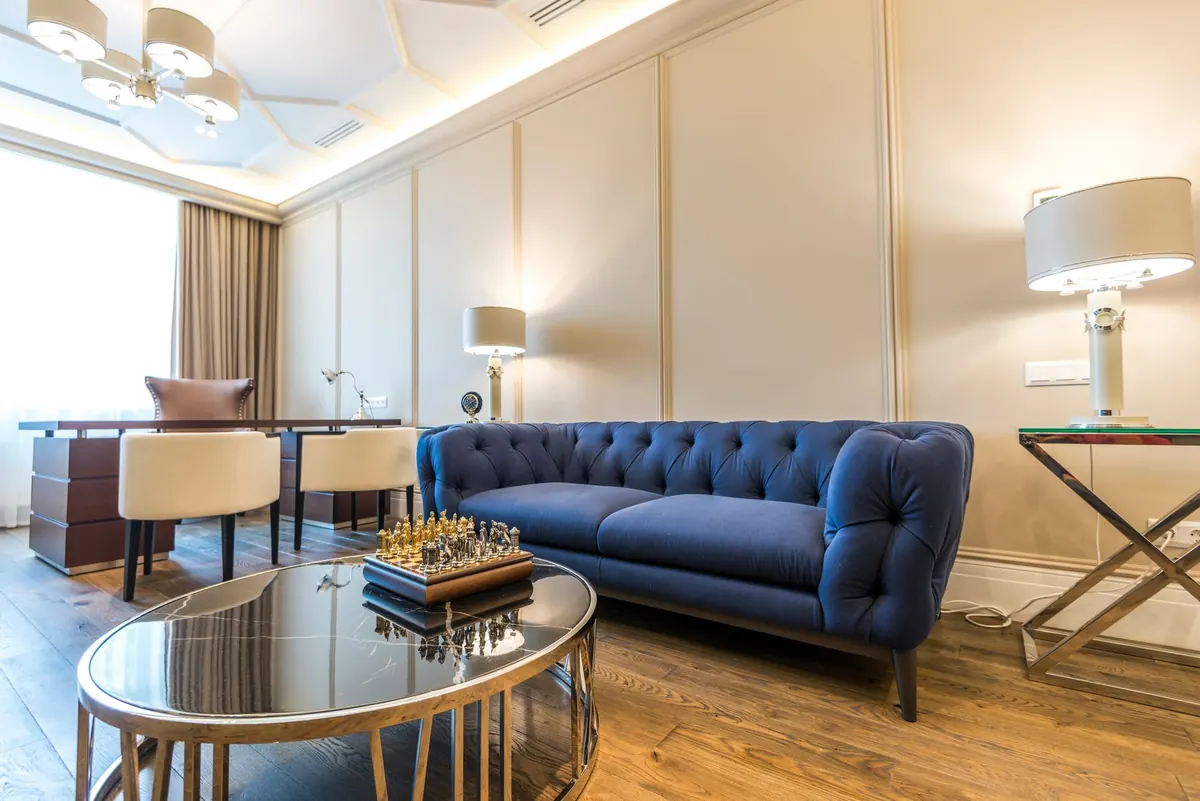
A small sitting room with one pendant in the middle of the ceiling can look perfectly pleasant by day and strangely flat after dark. The corners vanish into shadow, the walls seem to press inwards, and the whole room takes on the glare of a waiting room. Swap that single bright source for a few modest pools of light — a floor lamp beside the sofa, a table lamp on a side table, something warm grazing a wall — and the same space reads as deeper, softer and noticeably bigger.
That is what layering means: several light sources at different heights, doing different jobs, instead of one fixture trying to do everything. It costs less than new furniture and it changes the room more.
Think in layers rather than lamps. A compact sitting room usually needs a version of all four, in different amounts.
Use them in combinations rather than all at once. On a winter evening, ambient at low level plus one accent light is often plenty.
If your only ceiling fitting is a pendant with a bare bulb, everything else you add will be fighting it. Two changes make the biggest difference. First, a dimmer switch if the wiring allows, with dimmable bulbs to match — non-dimmable LEDs on a dimmer tend to buzz or flicker. Second, a lower-output bulb under a shade with a wide bottom, so light spills upwards as well as down. That upward glow softens the ceiling and stops the fitting reading as a bright spot your eye keeps returning to.
If you already have a grid of downlights, treat them as ambient only and run them at reduced brightness. In a small room the ceiling should be the quiet layer, not the main event.
Floor lamps are the most under-used pieces of lighting in small rooms. A lamp on a stand puts light roughly a metre and a half off the floor — high enough to wash a wall and reach the ceiling edge above it, which visually lifts the whole space. A slim floor lamp tucked into the corner behind the arm of a sofa lights that dark triangle nobody knows what to do with, and it takes up less floor space than a side table plus a table lamp.
Look for a shade wider than the base so the light spreads rather than concentrating. Angle the lamp so it grazes across the room or up a wall, never straight into the eyes of whoever is sitting nearest.
When you are sitting down, your eye line is around a metre from the floor. Light at that height feels intimate and flattering, and it breaks the habit of lighting everything from above. One lamp on a side table by the sofa, another on a narrow console or a deep windowsill, gives you two warm pools instead of one bright ceiling panel.
Choose shades opaque enough that you cannot see the bulb from where you sit — a visible filament is the quickest way to make a small room feel cheap. If two lamps flank a sofa, a mirror or a fireplace, use matching shades. Symmetry reads as calm and makes a compact room look considered rather than crowded.
Accent lighting is what makes a small room feel larger than its footprint, because it pulls the eye sideways and upwards instead of into the middle of the floor.
A slim wall light or a picture light above a sideboard creates a pool of brightness on the wall itself. Because the wall becomes the brightest surface you see, the room reads as wider. Plug-in versions need no rewiring, though if you want new wiring, a qualified electrician should do the work.
An LED strip stuck to the underside of a shelf turns a dark alcove into part of the room. Keep it warm white — a cool blue strip in a cosy sitting room looks like a shop fridge. Used behind a lamp or beneath a shelf, it adds depth without adding visual clutter.
Layering fails if the sources disagree with each other. Aim for one warm colour temperature throughout, somewhere around the warm-white end of the scale, so nothing looks stark beside anything else. Then make it easy to control.
Set the scheme up in one evening. Start with the floor lamp alone and notice how the room feels; add the table lamp; then bring the ceiling light in at its lowest useful setting. You will probably find you use it far less than you expected.
Adjust through the year. Dark winter evenings want more accent glow and a little less ambient; a bright summer night may need nothing but one lamp and an open window. If you share the room with someone who prefers it brighter, dimmers and separate switches are the peace-keeping tools — a layered scheme can be genuinely bright when it needs to be and soft when it does not. Get the layers right once, and a small sitting room stops feeling like a compromise.
Photo: Max Vakhtbovych / Pexels
A practical guide to buying second-hand furniture: how to measure, inspect and question before you commit, plus...
North-facing rooms needn't feel cold or dingy. Here's how warm colour, layered lighting, mirrors and texture can...
October 09, 2026 - DIY
October 05, 2026 - Interiors
Copyright © 2026 Amber Nest. All Right Reserved.