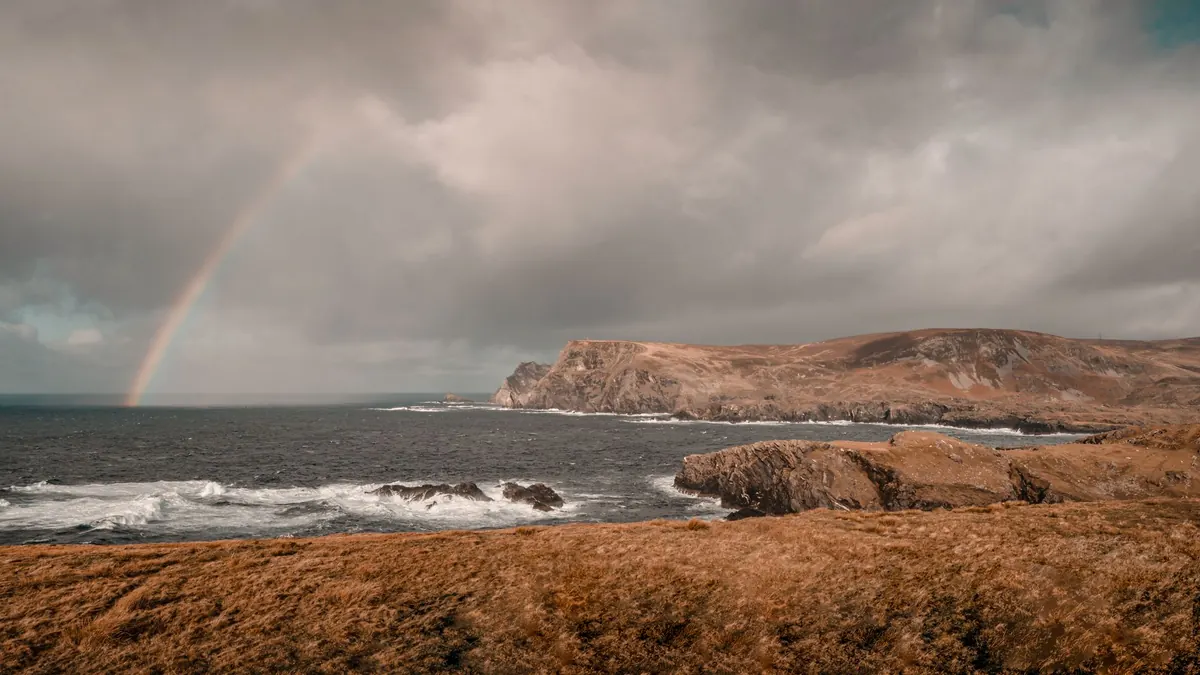
Walking the Coast in Winter: Shorter Days, Mud and Cold Winds
The same path you walked in June is a different proposition in January. The car park is half empty, the beach cafe has a note on the door saying "back in March", and by half past two the light has gone soft and grey. Coastal walking in winter isn't a worse version of summer walking. It's a different activity, and it rewards a different set of habits.
Get those habits right and a short winter day on the coast beats a crowded August one. Get them wrong and you'll spend the last hour of daylight squelching along a headland path in the dark, wondering why your legs have stopped working.
Start with the daylight, not the distance
In June, a 20 km stretch with 400 metres of climbing is a pleasant day out. In December it's a race you will probably lose. The route hasn't changed, but the ground has: mud, standing water and greasy rock all slow you down, and you'll stop more often to pull a hood up or adjust a layer.
So work backwards from sunset. Say the light goes at half four. You want to be off any exposed cliff section by quarter past three, with half an hour of contingency on top of that. If the walk takes four hours in winter conditions, you need to be walking by eleven, which means leaving home at nine. That's most of the day used up for eight kilometres — which is fine, as long as you planned eight and not eighteen.
Check the tide times before you commit to a date, too. Winter daylight and low-water windows rarely line up conveniently, and a route that depends on a low tide at three in the afternoon will finish in the dark.
Design routes that let you turn back
Point-to-point walks are a summer luxury. They commit you to a distance, a finish point and often a bus or a lift that may not exist in February. Out-and-back routes and circuits from a single car park are far more forgiving: you can cut the day short at any headland, and you already know what the return leg looks like.
Ask one question before you set off: where can I leave this path? A six-kilometre stretch with no road, no village and no footpath inland is a stretch where the decision to turn round gets taken out of your hands. If the weather turns, you walk through it rather than away from it.
If you're relying on public transport, check the winter timetable before you build the day around it. A service that runs hourly in July can be twice a day, or not at all, in January.
Underfoot: mud, shingle and cold rock
Winter ground is slower than summer ground for three reasons, and they rarely arrive one at a time.
Mud
Clay and chalk paths turn into a slip-slide within a few hundred metres of a farm gate. Waterproof boots with a deep tread earn their keep here, and gaiters save both trousers and socks. Poles help enormously on greasy descents and across wet shingle, though they're a nuisance anywhere that needs a handhold — stow them when the path turns scrambly.
Shingle
Wet shingle is one of the least forgiving surfaces on the coast. Every step slides back half a pace. If your route includes a long beach section, add serious time for it, more than the map suggests.
Cold, wet rock
Seaweed and green algae on rock behave like ice. Shaded and north-facing slopes stay damp all day, and wet wooden steps and boardwalks are their own hazard. Step where the rock is pale and dry, and test anything doubtful with a hand before you trust a foot to it.
Wind, spray and the temperature you don't feel
Wind is the thing that ends coastal days early. A headland in a stiff south-westerly feels several degrees colder than the car park, and spray does the rest. Two things follow from that.
First, the return leg can take far longer than you expect. Walking five kilometres into a headwind is not the same as walking five with it behind you, and there's no shelter on an open cliff path. Budget for it, or arrange the route so the exposed section is done early.
Second, dress for standing still as well as walking. A windproof shell over a warm mid-layer and a base layer, plus hat and gloves, is worth more than an extra fleece. Keep cotton away from your skin. Carry a snack and a drink where you can reach them without taking your rucksack off, and eat before you feel hungry — the cold catches up quickly once you stop moving.
A safety plan for a short day
Short days need simple plans, not complicated ones.
- Tell someone your route and your expected return time, and message them when you're off the coast — not when you reach the car.
- Carry a head torch on every winter walk, not just the ones you expect to finish late.
- Keep your phone warm in an inside pocket. Cold flattens batteries, and coastal signal comes and goes. A power bank is cheap insurance.
- Know your exit points before you start rather than when you need them.
- If something goes wrong on the coast, call 999 and ask for the coastguard. A grid reference helps if you have one.
If you're returning to coastal walking after a long break, or you have a heart or lung condition, it's sensible to speak to your GP before planning anything ambitious. Cold, wind and effort together are a bigger load than most people expect.
What you get in return
Empty paths. Waders and wildfowl packed onto an estuary at low water. Views through bare hedges that were closed in June. Low, slanting light on wet sand, and a flask of soup on a bench above a beach with nobody on it. The coast in winter is quieter in every sense, and it's the season you tend to remember.
A winter coast checklist
Before you leave the house:
- Sunset time, and a route that finishes at least an hour before it.
- Tide times for any beach, causeway or estuary section.
- Distance cut to roughly half your summer version.
- Waterproof boots, gaiters, and poles if the ground is greasy.
- Windproof shell, hat, gloves, spare warm layer in the pack.
- Head torch, charged phone, power bank, and a contact at home.
- Food and a hot drink you can reach without stopping.
- A named turnaround point, and the discipline to use it.
Walk a shorter route well and winter stops being the season you sit out. It becomes the one you plan around.
Photo: Raul Ling / Pexels


You Might Also Like
A worked two-day plan for an autumn or spring weekend on the Pembrokeshire coast, pairing a cliff walk with a sheltered paddle and a campsite base — plus what to book first.
Sand, salt and a steady onshore breeze wreck kit lists built for woodland sites. Here are the fifteen things coastal first-timers most often leave at home.